
Complete Excavator Rental Cost Bali 2026 – Operator, Fuel & Mobilization
Not a few project owners are surprised when receiving the final excavator rental bill — the amount is higher than they expected. Not because the vendor is cheating, but because there are several cost components that are often overlooked when preparing the project Budget Plan (RAB).
The hourly rate listed on brochures or vendor websites is indeed the most visible, but that is only one part of the big picture. There are fuel costs, unit mobilization costs to the site, and minimum rental hour requirements that all contribute to the total amount you must pay.
This article breaks down all cost components of excavator rental in Bali 2026 in detail, complete with real calculation examples, so you can create an accurate budget from the start.
Cost Component 1: Hourly Rate (Operator Included)
Hourly Rental Rate
This is the largest component of the total cost. At JKR, the hourly rate already includes an experienced operator — there is no separate operator fee. Rates vary depending on the unit used and the type of attachment (bucket or breaker).
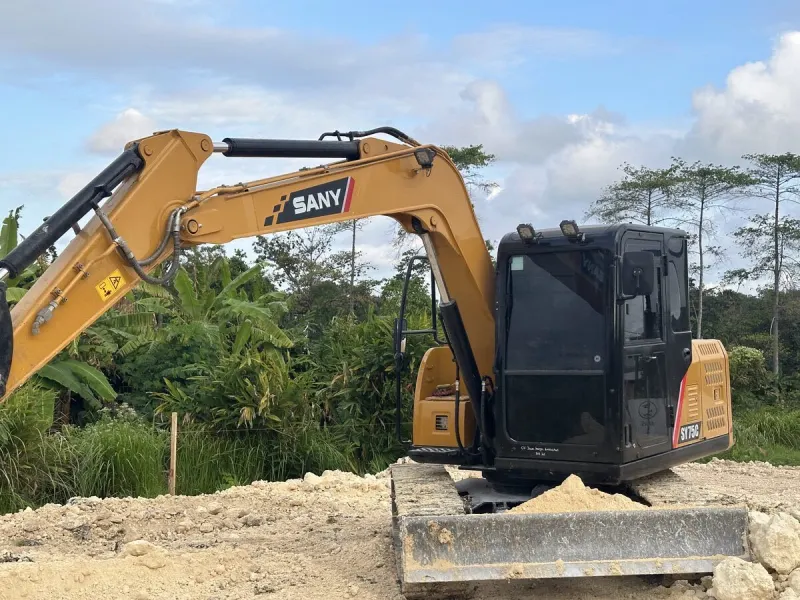
SANY SY75C is a 7-ton excavator suitable for medium to large-scale work: basement excavation, cut & fill, loading, and land clearing. The Kubota U30 is a 3-ton mini excavator ideal for precision work in confined spaces, narrow alleys, or villa areas with limited access.
| Unit | Attachment | Price Per Hour | Operator |
|---|---|---|---|
| SANY SY75C (7 ton) | Standard Bucket | Rp 395.000 | Included |
| SANY SY75C (7 ton) | Breaker / Hammer | Rp 495.000 | Included |
| Kubota U30 (3 ton) | Standard Bucket | Rp 300.000 | Included |
| Kubota U30 (3 ton) | Breaker / Hammer | Rp 400.000 | Included |
The price difference between bucket and breaker is quite significant because the breaker workload is much heavier — breaking rocks, concrete, or brickwork places extra strain on the hydraulic system and accelerates attachment wear. The higher breaker rate reflects greater operational and maintenance components.
Cost Component 2: Fuel
Engine Fuel
Good news: fuel costs for excavator operations at JKR are already included in the hourly rate. You don't need to think about or calculate fuel costs separately — just pay the hourly rental rate, and everything is covered including operator and fuel.
Although fuel is included, understanding excavator fuel consumption is still useful as a reference when comparing other vendors that may still separate fuel costs:
- Soft soil excavation (farmland, sand, loose soil) — lower fuel consumption, approximately 8–10 liters per hour because the engine load is lighter
- Hard or rocky soil excavation — consumption rises to the range of 10–12 liters per hour because the engine works harder to overcome material resistance
- Breaker work (breaking rocks, concrete, old masonry) — consumption can reach 12–15 liters per hour because the hydraulic system operates at high pressure continuously
- Loading and stacking light material — tends to be more economical, around 7–9 liters per hour
Need an excavator for your project?
Free consultation · Fast response · Transparent pricing
Cost Component 3: Mobilization
Unit Mobilization Fee
Mobilization is the cost of delivering the excavator from JKR's operational base in Canggu, Badung, to your project site — and picking it back up after the work is completed. Mobilization fees start from Rp 1.500.000.
Several factors affect the mobilization fee amount:
- Distance from Canggu — this is the biggest factor. Projects in Badung and Denpasar receive the lowest mobilization fee due to their proximity to JKR's base. Projects in Karangasem, Buleleng, or Jembrana require a higher mobilization fee due to the greater travel distance for the lowbed/trailer.
- Site accessibility — locations with narrow or rocky roads that are difficult for trailers to traverse require special route planning and sometimes longer travel time.
- Unit being delivered — the Kubota U30 is lighter and more compact; its mobilization is generally slightly easier compared to the larger SANY SY75C.
- Delivery time — deliveries outside normal operating hours or to locations requiring special coordination (e.g., areas with limited loading/unloading hours) can affect the fee.
The mobilization fee is flat — paid once for one rental period, not per day. So the longer the rental duration, the smaller the mobilization portion relative to the total overall cost. This is one reason why long-term excavator rental is far more economical.
For mobilization fee information to your specific project location, contact JKR directly — our team will provide an accurate estimate based on your site coordinates or address.
Cost Component 4: Minimum Hourly Rental
Minimum Rental Hours
The minimum rental hour policy is part of the billing structure that is often not well understood by first-time excavator renters. Understanding this policy is important so you are not surprised when you receive the invoice.
JKR's minimum rental hour policy is as follows:
| Attachment Type | First Day | Subsequent Days |
|---|---|---|
| Bucket (excavation, loading, cut fill) | 8 working hours | 4 working hours |
| Breaker (rock/concrete breaking) | 8 working hours | 4 working hours |
This means: if you rent an excavator with a bucket for one day and the work is completed in only 6 hours, you are still billed for 8 hours on that first day. If the project continues into the second day and is completed in 3 hours, the second day is billed for 4 hours.
This minimum policy is not meant to disadvantage clients — it is a standard industry practice that allows vendors to ensure operational viability, including operator costs, unit servicing, and mobilization logistics. By understanding this from the start, you can plan your work schedule more efficiently: for example, maximizing working hours per day so that the cost per unit of work volume becomes lower.
Want to calculate the cost for your project? The JKR team is ready to help calculate the cost accurately based on your project details — free, with no commitment.
Chat WhatsApp Now →Example Total Cost Calculation: 2-Day Excavation Project in Denpasar
Let's calculate the total excavator rental cost for a real-life scenario: a homeowner in Denpasar needs a SANY SY75C with a bucket to excavate building foundations over 2 working days.
Project details:
- Unit: SANY SY75C with standard bucket
- Location: West Denpasar (approximately 25 km from JKR base in Canggu)
- Duration: 2 days × 8 working hours per day = 16 hours total
- Soil type: medium soil (mix of soil and gravel)
| Cost Components | Calculation | Estimated Cost |
|---|---|---|
| SANY SY75C bucket rental rate (including operator + fuel) | 16 hours × Rp 395,000 | Rp 6,320,000 |
| Mobilization fee (Denpasar) | PP from Canggu, ~25 km | Rp 1.500.000 |
| Total Estimate | Rp 7,820,000 | |
Estimated total cost of a 2-day excavation project (SANY SY75C, Denpasar):
± Rp 7,820,000Important notes on the calculation above:
- Hourly rate is all-in: operator + fuel included — no hidden additional costs
- Mobilization fee may vary depending on the specific location and road accessibility
- Both days meet the 8-hour minimum rental for the bucket, so no minimum hours are missed in this example
For projects using a breaker, or for locations outside Denpasar (e.g., Gianyar, Tabanan, or Buleleng), mobilization fees will differ. Always confirm the full estimate directly with the JKR team before starting a project.
Tips to Save on Excavator Rental Costs
By understanding all the cost components above, there are several strategies you can apply to maximize budget efficiency:
1. Plan Your Schedule Carefully Before Booking
Determine the scope of work in detail before contacting the vendor. How many excavation points? What is the estimated volume? Is there any work that can be completed sequentially in one long session, rather than spread across several short days? The clearer the work scope, the more accurate the cost estimate you can calculate — and the easier it is to optimize the schedule to avoid cost overruns.
2. Combine Different Jobs into One Session
If your project involves multiple types of work — such as foundation excavation, land leveling, and material piling — plan for all of them to be completed within one continuous rental period. Mobilization fees are only incurred once, so the more work completed in a single rental, the lower the mobilization cost per unit of work volume.
3. Maximize Working Hours Per Day
Since there is a minimum rental hour requirement, make sure you are ready to fully utilize those hours. This means: the site is clear of obstructions, waste material disposal is planned, the project supervisor is on site, and coordination with other parties (neighbors, road managers, etc.) is complete. An excavator waiting due to site unreadiness still counts toward rental hours.
4. Choose the Right Unit for the Job
Do not always choose the largest unit. The Kubota U30 at a rate of Rp 300,000/hour can be very efficient for work in confined areas or tasks that do not require the full capacity of a SANY SY75C. On the other hand, using a mini excavator for large-volume work is inefficient because it takes longer. Consult with the JKR team on unit selection for the right recommendation based on your project's actual conditions.
5. Book Early to Secure an Ideal Slot
Last-minute bookings are often inflexible in terms of schedule. By booking early, you have the flexibility to choose the optimal start day and time — including avoiding busy days where mobilization may take longer due to traffic conditions.
Summary of All Cost Components
| Component | Covered By | Notes |
|---|---|---|
| Hourly rate (including operator) | Client | Starting from Rp 300,000/hour. See table above. |
| Fuel cost | Included (JKR) | Fuel is included in the hourly rate — no additional charge |
| Mobilization fee | Client | Starting from Rp 1,500,000, depending on distance from Canggu |
| Minimum rental hours — first day bucket | — | 8 working hours |
| Minimum rental hours — first day breaker | — | 8 working hours |
| Minimum rental hours — subsequent days | — | 4 working hours (bucket or breaker) |
For bore pile and dump truck pricing, see the JKR complete price list. If you still have questions about cost components or how to calculate estimates for your project, visit the FAQ us or contact us directly via WhatsApp.
Choosing the right excavator isn't just about finding the lowest hourly rate — it's about fully understanding the overall cost picture, planning properly, and choosing a transparent vendor from the start. With the information in this article, you are well-equipped to start the right conversation with any vendor, including JKR.